Key Factors Determining Lithium Battery Capacity
Does your phone’s battery never seem to last long enough? The cycle from full charge to shutdown has become a daily source of anxiety for many people today. When we talk about battery life, what exactly are we talking about? Today, let’s set aside overly technical jargon and discuss the practical realities of battery capacity, as well as the practical choices offered by NOHON, the expert in long-lasting batteries.
Voltage: A stable foundation
The standard operating voltage for mobile phone lithium-ion batteries is typically 3.7V (rated voltage), while the charge cutoff voltage is generally 4.2V or 4.35V. The voltage plateau determines the “thrust” of the electron flow and defines the battery’s operating window, but it is not a direct determinant of capacity. A stable and consistent voltage output is the foundation of a good user experience.
Battery Cell: The physical carrier of capacity
The battery cell is the core unit for storing energy, and its material structure and manufacturing process jointly determine its maximum capacity. The energy density of a battery cell—that is, the amount of electrical energy stored per unit volume or weight—depends on:
Cathode material: High-end batteries use high-nickel ternary materials, which store 15–25% more energy than traditional lithium cobalt oxide.
Anode material: Silicon-carbon composite materials increase capacity by more than 30% compared to traditional graphite anodes.
Electrolyte formulation: Optimizes lithium-ion transport efficiency and reduces internal resistance losses
In addition to energy density, improving space utilization within safe limits is the primary way to increase capacity. For battery cells of the same specification, actual capacity may vary among different manufacturers. Factors such as the uniformity of electrode coating, the precision of electrolyte filling, and the rigor of aging and capacity sorting processes can all affect actual capacity.
NOHON’s pragmatic approach
NOHON has always adhered to one principle: all battery cells are sourced from high-quality suppliers with full 3C certification. China’s consumer lithium-ion battery industry has become one of the world’s most mature and comprehensive supply chain systems. NOHON fully leverages this industrial advantage, upholding the principles of compliance, maturity, and reliability. We carefully select battery cells that have been proven by the market over the long term, prioritizing consistent batch quality, mature and reliable material systems, and a safety record that has stood the test of time.
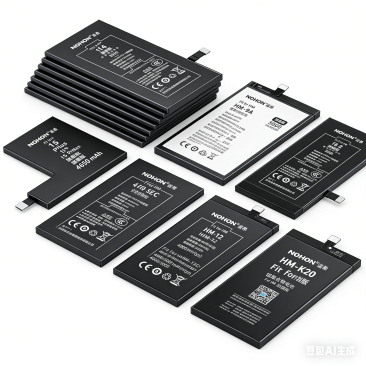
In applications with strict size constraints, such as mobile phone batteries, NOHON matches the most suitable cell specifications to the power consumption characteristics of each phone model. Rather than blindly pursuing theoretical specifications, we prioritize real-world battery life performance. Every batch of cells undergoes 100% inspection before being accepted into inventory to ensure that key parameters—including capacity, internal resistance, and self-discharge rate—fully meet standards.
Based on an understanding of users’ varying needs, NOHON offers different battery capacity upgrade options compared to the original device:
The Premium Edition battery, with a 15%–25% increase in capacity, is designed for users seeking maximum battery life;
The Flagship Edition battery, with a 5%–10% increase in capacity, is designed for users looking for value when upgrading from an older model.
NOHON believes that superior battery technology is not merely about technical specifications, but about providing users with a sense of peace of mind that makes them forget the battery is even there. This is made possible by China’s mature lithium-ion battery supply chain, a strict commitment to compliance, and an unwavering dedication to reliability.